Saturday, June 16, 2012

Thailand, China, and Mongolia


View Sabbatical in a larger map


Well, once again I'm behind on my updates. I'm currently sitting on a ferry going from Helsinki, Finland to Stockholm Sweden. Obviously, both of those places are a long way from Indonesia, which is where I last left off. Sorry. 


A lot has happened since then, but in the interest of time and (hopefully) getting you all up to present-day in my story as soon as possible, I'm going to make this more a of a bullet-point summary of Southern and Eastern Asia. I feel bad about doing this because these were very interesting places and I have lots of stories to share – I just don't have time (or energy) to write about them right now. You'll just have to get the rest of the stories next time you see me :-) 


I think I've said before that I'm constantly trying to figure out the optimal balance for my time. It's always split between three things: enjoying and experiencing the current moment, writing about and digesting what happened in the past weeks, and planning/logistics for the coming weeks. All three are equally important, and somewhat mutually interdependent, but since I've been changing locations so frequently and covering so much ground so fast, my writing has been loosing in the tug-of-war. Alright, enough with the excuses.  


I knew before I started on it, that this section of my trip would be a bit different in that I would spend most of my time in transit, only stopping for layover and rest days, rather than taking time to actually get acquainted with places. This was a necessary evil in order to maximize the time I had to spend with friends. As I've said before, I know that I have much more fun visiting people I know rather than sightseeing by myself,  skipping out on some things along the way, for example, the Great Wall of China. 


Thailand

  • A short flight from Jakarta, Indonesia to Kulua Lumpur, Malaysia, and then an overnight train on into Thailand. This was my first experience with sleeper trains. I enjoyed it. Way better than buses. It's a good thing that I liked it because there were many more nights on trains to come. 
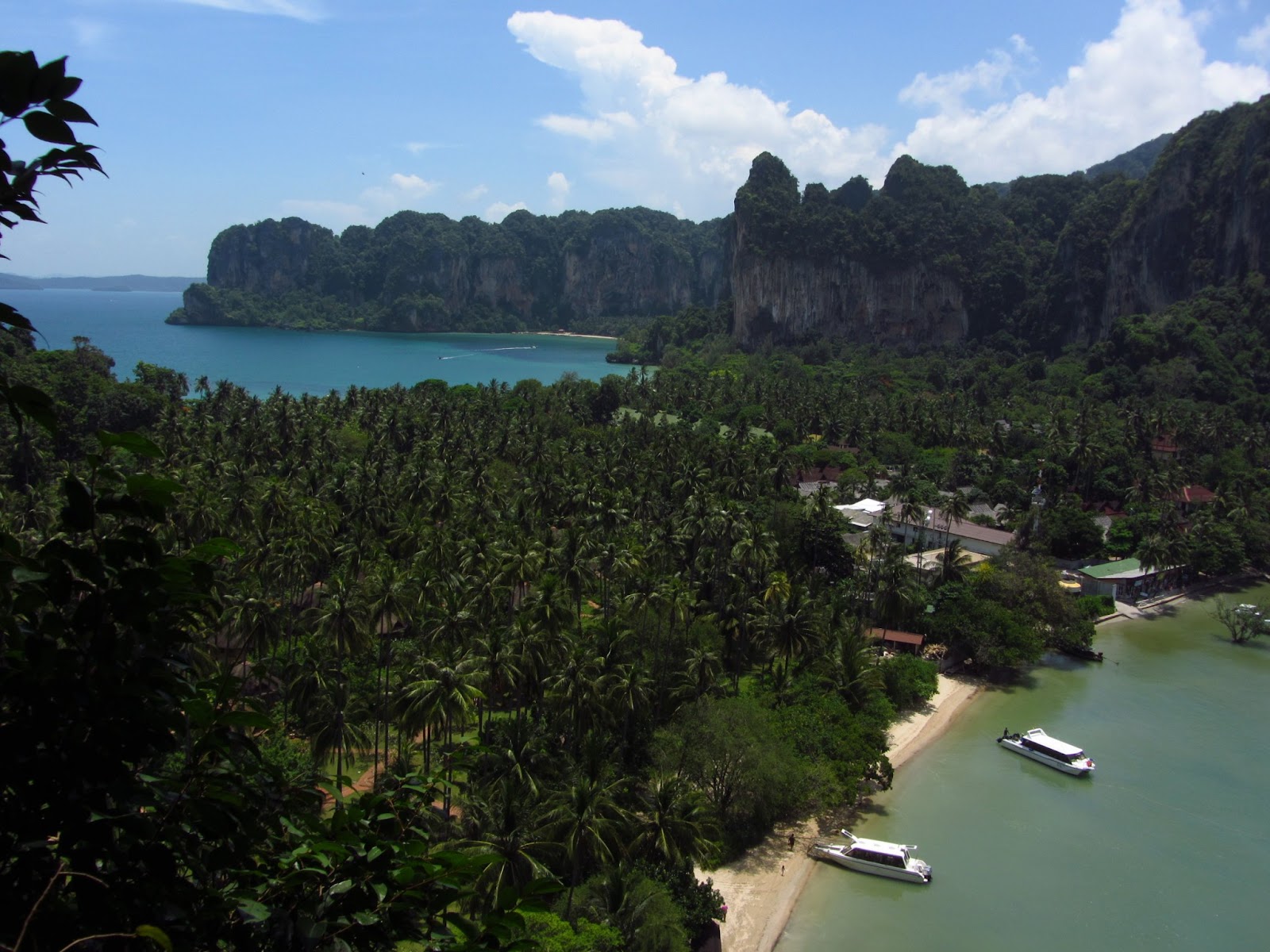
  • I stayed 2 nights at Railay Beach near Krabi, Thailand. A wonderful picturesque beach, with warm water, white sand, and lush jungle on all sides. Combine those with relatively cheap prices and great climbable limestone cliffs all over and you can understand why it's a favorite destination for climbers. 
  • Overnight van/bus combo to Bangkok. The price was too good – I should have known something was fishy. We only stopped at places where the only food, water, and toilets in sight were owned by friends of the drivers. During the night, the luggage we had placed under the bus was searched for valuables. Unfortunately, this is something that is fairly common in Thailand (the bus drivers are in on it), so most of us kept our valuables in our carry-on bags. I slept with my small carry-on in my arms or with my feet in the straps in such a way that I would feel it if it were moved. The girl behind me had her backpack at her feet, but someone still stole her iPad. There is a lot that could be said about this, but worst part for me the is feeling that you and your stuff aren't really safe while you're sleeping. 
  • Spent half a day in Bangkok waiting for the train headed for Laos. I visited Bangkok during my last trip to Thailand/Laos, so there wasn't much that I wanted to see, but I did enjoy getting out and seeing some new sections of the city. 

  • The night train was uneventful. It felt very restful and secure compared to the night before. When we arrived in Laos the next morning, I was talking with some other travelers about my plans to continue on to Vietnam via bus later that day. They asked if it had been easy to get my visa for Vietnam. What visa?!? I had read that there was a visa-on-arrival option for Vietnam, but apparently even that option requires some kind of letter in advance. Quick research on the train (thankfully I had saved the info to my computer) revealed that getting the visa in Laos would take at least 3 days – days I would have to sacrifice from somewhere later in my schedule. I started looking for alternatives. Was there a way to get into China without going through Vietnam? Answer: Yes! The guy at the hostel said the bus was leaving for Kunming, China in less than 2 hours, so I had to make a decision fast. It wasn't an easy decision. First because it was a 50 hour bus trip on bumpy roads through a part of Laos and China that doesn't get tons of visitors. And second because it would put me on a completely unplanned route for at least the next 4 or 5 days. I would be back on on schedule by the time I got to Beijing, but I didn't know anything about the places or route in between. Also, keep in mind that I had spent the last night/day on a train and the night before that on a sketchy bus.   Contrary to what might seem like an obvious decision, I quickly bought some more food and drinking water and hopped on the bus.
  • This was my first (and maybe last) trip on a sleeper bus. Instead of seats, they have narrow bunkbeds stacked 2 or 3 high. Apparently very common in China for long trips, and probably the most comfortable way you can spend a 50 hour bus ride. It's still a bus, and the roads are still bumpy, but it could have been worse. I slept a lot, looked out the window, listened to all of my podcasts and read travel guides. No one else on the bus spoke English, so the purpose of our stops was always a surprise – I had to watch everyone else to figure out if it was a food-, bathroom-, gas-, water-, or smoke-break. Not that we needed the smoke-breaks; everyone seemed perfectly happy to just smoke on the bus. :(


China

  • Border crossing into China went over without a hitch. Hooray, my visa worked!
  • I spent 3 nights in Kunming. I didn't do much sightseeing there, but I needed a couple days to recover after spending the last 4 nights in buses and trains in 3 different countries. In Kunming I stayed a very comfortable hostel and spent a lot of my time on my laptop figuring out train schedules to Beijing, Mongolia, and Russia, making couchsurfer connections in those places, and refining my schedule for parts of the trip further down the road (and double checking that I wasn't making any more silly mistakes like that visa for Vietnam). I did do a little sightseeing in Kunming. Check out the photos. 
  • The train from Kunming to Beijing took 2 nights. I had a really good time on that train ride. It was clean and comfortable, and the 5 other people sharing my compartment/berth area were really friendly. One girl spoke pretty good English so she helped translate. The views out the windows during the day were pretty nice too. Small talk via translation and hand signs got old after a while, so I decided to see if they wanted to learn some knots. I had some rope (useful for many purposes when traveling), and knots are easy to share even without words. They loved it! Especially the grandma in the group – she kept calling me teacher and wanted to learn every knot I could show her. They kept practicing over and over until they got them all – bowline, square, figure eight, double fisherman's. I loved it too. [Yes, Chris Swift, I can hear you laughing already]. 

  • I spent 2 nights in Beijing. Just enough time to have dinner with a couchsurfer, figure out how to book my train ticket to Mongolia (not as easy as you would expect), and see some of the main sights.  It might have been the weather or just the timing, but Beijing wasn't my favorite place. There were some nice things to see, and I'm sure even more nice things I didn't see, but I'm happy I didn't schedule a long stop there. 
  • The train from Beijing to UlaanBaatar, the capital of Mongolia) worked out perfectly in the end, but but there was a lot of uncertainty initially. There are three options for getting to UB: 


    1. Since this is the first leg of the Transmongolian Railway (one of the Transiberian routes), so you can buy a ticket on one of those trains. It will cost of about 200$US, takes 1 night, and departs twice a week. 
    2. They attach an extra carriage to the back of the Transmonglian trains. The extra carriage stops at the border when the rest of the train continues into Mongolia. It's a lot cheaper since it's not international, but you have to get out at the border town, spend the night, and then cross the border the next day by jeep and catch a Mongolian train on the other side. Total cost around 60$US and takes 1 or 2 nights depending on the mongolian trains. 
    3. The third option in a combo of 1 and 2. You buy a ticket for the cheap, non-international train carriage and then while you're en route, if there are extra beds in the international train you can pay the conductor for an upgrade at a highly discounted rate. But, if there aren't any extra beds, you have to fall back to option 2 and spend the night in the town in the middle of nowhere. Total cost of about 100$US and only 1 night. 


  • I was lucky and option 3 worked for me! Upgrading to the international train also meant that I was, for the first time in about a week, traveling with other Westerners again. I enjoy traveling with locals and getting the immersion experience, but on those long trips sometimes it's nice to be able to speak English. 
This is where the track widths change from the standard size to the Russia size. The bogies have already been switched in this photo. 


Mongolia 

  • I only spent 2 nights in UlaanBaatar, and since Mongolia is such a huge place with relatively poor transportation infrastructure, most of what I saw for Mongolia was from the train on the way to UB and from UB to Russia. What I saw from the windows was really beautiful, especially in the north: rolling hills covered in grass, semi-nomadic families living yurts (locally called “gers”), some of the cleanest looking water, and pretty rives. The southern part I didn't see as much of since we went through at night, but it's a lot of really big desert. 

  • UB itself was interesting. It's a big city, but not very dense. They have a lot of room to spread out. Half of the country's population lives there, but the low density leads to a certain feeling of disorganization. There are some nice sights in town (see the photos) and the people were nice. I tried some traditional food, which as you would expect coming from a nomadic culture is largely based on animal products – meats and cheeses. I did like some of the foods (eg buuz ), but others (eg milk tea) I did not. 
  • From UB, I took a train straight into Russia, all the way to Irkutsk, near Lake Baikal (oldest, deepest and most voluminous freshwater lake in the world), but you'll have to wait until the next post to hear about Russia. 
--- I updated the map, photos, and itinerary sections, so go check out the new additions in the links above --- 


Thursday, May 31, 2012

Indonesia

From Japan I took a flight to Indonesia with a layover in Singapore (which has one of the nicest airports I've ever seen). My purpose for going to Indonesia, and part of what motivated this whole trip, was the chance see my brother whom I haven't seen in a couple years. With that in mind, I was a little disappointed that he couldn't meet me at the Jakarta airport because he was working the night shift, but in his place he sent one of his Indonesian friends, Debby. Having Debby there was great – she speaks Indonesian, so the taxi driver didn't try to scam us - and shes a lot better looking that Ryan anyway.

Debby and I at the airport. 
After the go-go-go pace at which I went through California and Japan, I needed a couple days to relax, so I checked into a "nice" hostel (still only about $10/night) near where Ryan lives and set up camp. I spent some days poking around parts of Jakarta, meeting with Ryan and his friends, catching up on emails, researching the next stops on my trip, talking with other travelers at the hostel (including a primatologist doing research in remote Indonesia), having lunch at the US Embassy (sorry, no photos allowed), finally receiving the debit card for which I've been waiting 3 months and as many countries, and trying to get my Russian visa.

Inside the Russian Embassy in Jakarta
Russian visas are notorious for being some what difficult to obtain. In fact, there are entire websites and companies dedicated to helping you negotiate the process. In the past, if you filled out the right paperwork, got your letter of invitation, had all of your ducks in a row, and paid the right fee, you could get a visa for Russia at almost any Russian consulate in any country. However, in recent years, they've started enforcing a rule requiring your visa to be issued from a consulate in your home country.

For this reason I wanted to get my visa while I was in California, but due to the visa processing times and my flight to Japan, it was going to be cutting it all too close. I decided I would ask at the embassy in Jakarta, and if they said no I could mail my passport back to the States to get the visa. Mailing it back would mean being in a foreign country without my passport for at least 2 weeks – a somewhat risky endeavor – but it seemed like the only choice. I was in luck though; at the Jakarta embassy I asked my question, waited an hour for an answer, and after a brief hesitation they said, “yeah, sure just pay your 250$US fee for rush processing and it will be ready in a week.” A week later, I had my visa in hand. Success! [250 might seem like a lot, but the normal, slow fee in the US is 140, the rush fee is 250, and you can add to those 120 if you have an agency help you. And if you include parcel service back to the US, I was coming out waaay ahead for only 250$.]


Spending time with Ryan and his friends was an interesting experience. They are an eclectic mix of US Marines, Indonesians, and various expats who work at the embassy. Jakarta has a high degree of income inequality, and high rates of poverty, but this group (with some exceptions) exists primarily in a bubble of relative wealth that surrounds the embassy. I don't want to come off as sounding judgmental as I'm sure I would be in that bubble too if I lived there, but as always, the contrast, proximity, and mixing of the two extremes was interesting.

Ryan's friends are a fun group. I especially enjoyed chatting with some of his Indonesian friends. They spoke great English, so it was a good opportunity for me to get answers to some of the cultural questions that had been lingering in my mind.

My family will be happy to hear that Ryan's friends and acquaintances (I met his boss too) all had really great things to say about him. They said he's friendly, helpful, funny, and always taking care of people when they're unwell. They say he can be a bit mischievous at times (I could have told you that), but they were always really happy to see him when we walked into a room. No one would believe we were brothers at first glance. One guy even forced me to show my passport before he would believe me. I also thought it was funny that despite being taller and more handsome (I'm including these comments because Ryan said he's been ignoring my blog – I'll show him) … despite being taller and more handsome, his friends often thought I was the younger brother. Ha!

This isn't a particularly flattering photo of either of us, but really, who's better looking?
After spending a little over a week in noisy, crowded, polluted, traffic-clogged Jakarta (Chuck, you were right), I was in need of a break. I also didn't want to leave Indonesia with Jakarta being my only impression of the country. A group of students from Canada that I had met at the hostel had gone to Jokjakarta which is said to be the cultural center of Java (Java is island on which Jakarta is located). The chance to have companions for sightseeing and other activities for a change was too good to pass up, so I took the very scenic 8 hour train ride over to Jokja and met up with the anthropology students from Toronto.


And I was not disappointed. I had a really great time there. Good food, great conversations, and a visit to Borobudor – the giant temple in my photos – where we got to see, despite my attempts to leave earlier, an annual Buddhist ceremony with these magical flying lanterns.

There were many great parts about my time in Jokja, but one of the highlights was the food at the homestay where I stayed. 2 meals and day, free internet, and laundry was all included in the 15$/night in this beautiful house with lots of intricate woodwork and panels. And the food they cooked was wonderful. Lots of traditional Indonesian dishes and some borrowed from nearby countries. It wasn't the cheapest place in town, but it was a great bargain for what you got.

Sitting down for a great dinner at the luxurious homestay in Jokja.
After traveling relatively solo for so long – making my own plans, setting my own schedule, changing plans at whim – it was a bit difficult for me to be in a bigger group (15?) where we spent a lot of time waiting for people or somewhat blindly following the leader without knowing exactly where we were going or what was going to happen next. I had a great time with them in the end, but was sometimes good exercise for my patience :)
At Borobudur 
The Indonesian and Canadian students
Lantern lighting 

After Jokja, I took the train back to Jakarta, met Ryan for one last dinner, spent the night in a hostel, and then headed to the airport. Coincidentally and appropriately, I once again met Debby at the airport. She had missed a flight earlier that morning to go do some wedding planning, so she was waiting around for the later flight. We had a short chat, then I got on the plane headed for Malaysia. My original plan had been to take the ferry from Indonesia to Singapore so as to avoid the flight, but the flight was shorter (by about a day), safer (Indonesian boats are known for far exceeding capacity, and sinking), and cheaper (by about half), so I couldn't pass it up. It was a good decision, but I hope it's the last flight I take until the one from Europe back to North America.

More photos and videos (I finally got the videos uploaded) from Indonesia are linked from my photos page.

Stay tuned for a post about Thailand, China, and Mongolia. In the mean time, keep track of my progress on the maps.

Saturday, May 26, 2012

Japan


Fore-note: I added a page with a rough itinerary for the rest of my trip. I'd love to hear your thoughts and suggestions.
____________

Shorty after I blogged about my excitement for Japan, I hopped on what felt like a quick 12-ish hour flight (I stop counting after 8) and was teleported to the Land of the Rising Sun.


During the flight I spent a lot of time studying the culture and language and reading about Tokyo. Upon landing I immediately wished I had had more time to prepare. Japan felt so foreign in so many ways. If it hadn't been for some of the signs being in English, I might not have been able to find my way out of the airport. It's not that anything was particularly confusing or disorganized, quite the opposite in fact, it's simply that the culture and writing were so instantly different from what I was used to. A little culture shock and an unwillingness to try to decipher the strange writing.


I spent the first day in Tokyo visiting many of the popular tourist sites, walking around, taking photos, gawking at the “strange” clothes and “weird” customs, and very quickly learning how to efficiently use the subway system. That first day felt in many ways like a practical exam. The day before had been 8+ hours in the plane of intense cramming about sights, sounds, language, and customs I had never really heard of before, then in the morning I was immediately immersed - sink or swim. I had to practice what I had tried to learn and attempt to find the places I had read about for the first time the day before. It was a little surreal. I read about things in a book, and then the next day there they were in real life.


By the end of the first day, much of my initial culture-shock induced anxiety had gone away (along with my jet lag, now that I think about it).  I suspect the speed and ease of that transition was largely due to the incredibly helpful and friendly people I met. During my first 2 days in Tokyo I was approached in the subway by no less than 5 different people who asked if I needed any help. This included one lady who offered her help despite the fact that she couldn't speak English. She used her smart phone to translate her offer from Japanese to English and showed me the text on her display. In that case I actually did know where I was going, or thought I did anyway, and I told her as much. Later when I tired to get off the train at the wrong stop, she chased after me (risking getting stuck at the wrong stop as well), and made me get back on the train. After experiences like that you can't help but feel welcomed and happy to be somewhere.
Wonderfully detailed and properly oriented maps like this were all over the cities in Japan. 

Having people come to me with honest offers to help was in such stark contrast to many of my recent foreign travel experiences, that it took some getting used to. In those other places, whenever someone comes up to you they are either trying to sell you something, get you into their taxi, or scam you in some other way. I was so used to this behavior that I almost completely ignored the first guy in Japan who offered his help. I was very suspicious, but I'm glad I didn't, because he probably saved me at least an extra hour in the train my first night. Lesson learned (once again): new culture = reconsider all of your previous assumptions.

I only spent 2 days in Tokyo, and then I jumped on a shinkansen (aka bullet train) to Okayama where my friend Ray lives. Visiting Ray was the primary reason I decided to stop in Japan on my way to Indonesia. I've learned through experience that I enjoy places much much more when I visit people I know even if that means skipping out on some touristy things. This was the case in Okayama – there are some really nice things in and around Okayama, but if you only had 1 week in Japan, it probably wouldn't be on the top of your list. But Okayama was the highlight of my trip!

Breakfast at Ray's apartment

Back story: For those of you who don't know, I first met Ray about 6 years ago when I was in Germany for a summer school program about Sustainable Energy Supply. After the summer school, I needed a place to stay for six weeks while I was doing an internship in Dresden with a company that installs solar panels. After meeting Ray's roommate slacklining in a park and inquiring about short-term rooms for rent, I ended up sleeping on their couch for the rest of my time in Germany. Since then­ we've stayed in touch off and on through emails, facebook, and proofreading the occasional section of a master's thesis.

In Okayama, Ray helped me rent a bike and we peddled all over town the first day – visiting a really nice park, seeing his kyudo dojo, and going to an Onsen. Onsens probably deserve a post of their own since they're a prominent and interesting part of the culture, but instead I'll just direct you to this article. The one we went to was very nice – rock work around the pools, saunas, indoor and outdoor parts, and some very very hot stone floors which you were supposed to lay and relax on (but no more than 5 minutes at a time lest you cook your insides). And I think it was all less than 5$. Now I know why they're so popular.

Getting ready for the onsen.
Ray's girlfriend, Machi, is Japanese, and she lives with her family not far from Ray's apartment. In addition to seeing Ray again, getting to spend time with Machi and her family made my experience in Japan very special. They invited us over for lunch one day, so I got to see how they live and what they like to eat. It was really great. Their house was beautiful, the food was wonderful, and they are an incredibly kind and welcoming family which further convinced me that the Japanese must be some of the nicest people around.

Cooking with chopsticks

One day I decided to get out of the city for a little bit so I took a train to a small town, walked around a small park, and hiked a bit in the hills. After time in San Diego, LA, Tokyo, and then Okayama it was nice to be surrounded by farms and trees instead of just building and streets.


My last night in Japan, we met with Machi's family for a very delicious and traditional dinner at a Japanese pub called an izakaya. The food was wonderful. Everything comes in really small portions, like appetizers, so you get to try a lot of different things before you're full. Things like sushi, squid, vegetables, little bits of cooked meat – too many things to list; look at the photo. Another  interesting part of the izakaya is that it's a place where the Japanese relax much of the formality and “face” that is expected during the workday and allow a more casual, laughing, smiling atmosphere. I really enjoyed seeing the contrast.

at the izakaya
Once again, this was an experience I most certainly wouldn't have had without Machi's family (particularly her dad; he did all of the ordering for us). Ray and I were the only non-Asians in the room. And no way would I have figured out what order or how much … and for that matter, how to eat some of the items. Once again, Machi's family wins the hospitality award. These are the kinds of experiences that, for me, making international travel worth while.


Despite the rough start, I left Japan with a high regard for their culture. Many travel books will tell you Japan is a study in contrasts – new and old, high tech and ancient, giant sky scrapers and meticulously constructed parks. I found this to be a an accurate description. I like that the old customs are still quite strong and mixed with the new. The food was tasty, the sidewalks clean and orderly, the traffic well behaved (more bicycles than I've ever seen in my life), and the people friendly, happy, and welcoming.

Check out the photo album for more photos, videos, and captions.

A huge thanks to Ray, Machi, her Dad, and rest of her family for hosting me and making it a great experience!